Background: The Final Months of the Civil War
By late 1645, the Royalist cause was in serious difficulty. The decisive Parliamentarian victory at the Battle of Naseby in June 1645 had destroyed the King's main field army. In the South West, however, Lord Ralph Hopton commanded a substantial Royalist force that continued to hold much of Devon and Cornwall.
Sir Thomas Fairfax and the New Model Army spent the autumn and winter of 1645–46 methodically reducing Royalist garrisons across the region. Tiverton fell in October 1645. Dartmouth was taken in January 1646. By February, Hopton had concentrated his remaining forces in Great Torrington, which occupied a strong defensive position on a hilltop above the River Torridge.
Battle Map — 16 February 1646
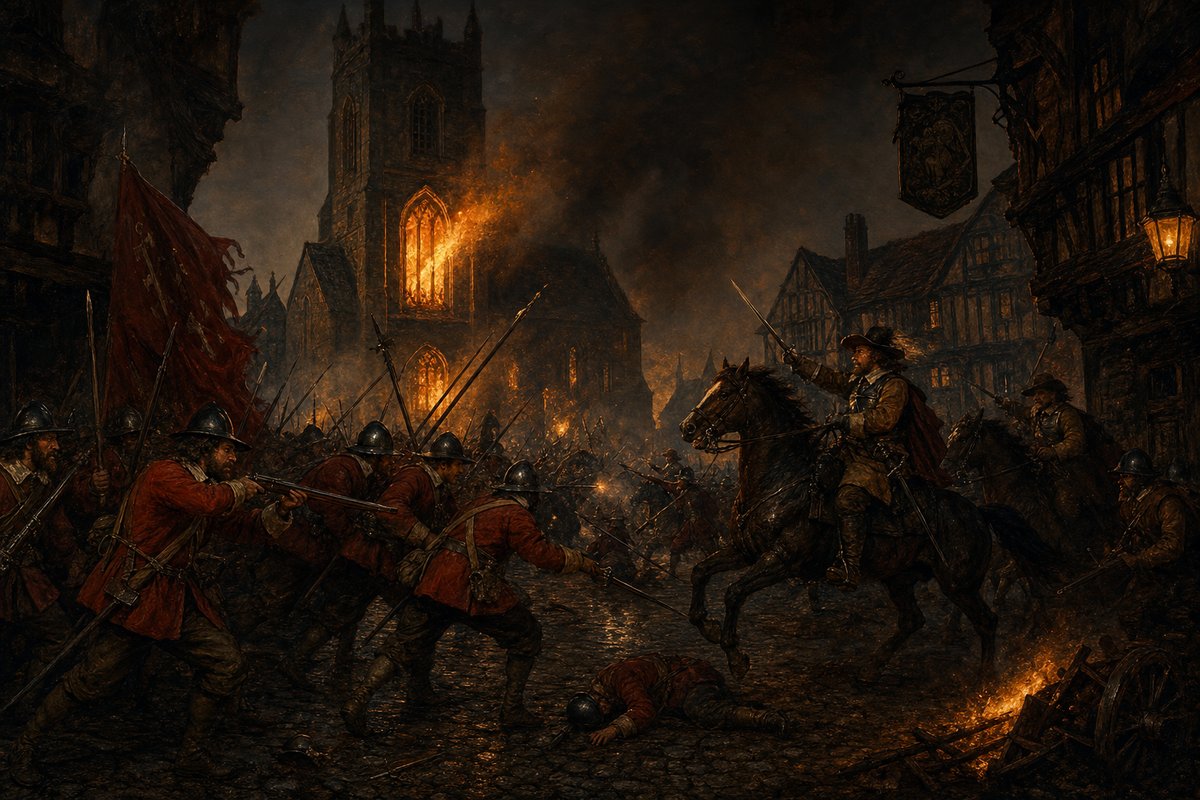
The Night of 16 February 1646
Fairfax's army arrived before Torrington on 16 February 1646. The initial Parliamentarian attack was repulsed, and fighting continued into the night — an unusual circumstance for Civil War engagements, which rarely took place after dark. The narrow streets of the town became the scene of fierce close-quarters combat.
Hopton's cavalry made several sorties in an attempt to drive back the attackers. For a time the outcome was uncertain. But Parliamentarian numbers and discipline ultimately prevailed, and the Royalist position in the town centre began to collapse.
The Church Explosion
The most dramatic — and catastrophic — moment of the battle came when St Michael's Church exploded. The Royalists had stored approximately 80 barrels of gunpowder inside the building. As Parliamentarian forces advanced into the churchyard, the powder ignited in a massive explosion.
"The church was blown up with near two hundred prisoners in it, and the whole roof carried into the air with a most hideous noise."
Contemporary accounts describe the explosion as visible for miles around. Around 200 Royalist prisoners who had been confined in the church were killed instantly, along with a number of soldiers on both sides. The shock of the explosion effectively ended organised resistance within the town.
Whether the explosion was accidental — caused by stray sparks in the confusion of battle — or deliberate remains a matter of historical debate. Some accounts suggest a Royalist soldier set off the powder to prevent it falling into enemy hands. The evidence is inconclusive.
Aftermath and Significance
Hopton escaped with the remnants of his cavalry and retreated westward into Cornwall. Fairfax pursued, and within weeks the western Royalist army had effectively disintegrated. Hopton formally surrendered at Truro on 14 March 1646.
King Charles I surrendered to the Scottish Covenanting army at Southwell on 5 May 1646, bringing the First English Civil War to an end. The Battle of Torrington had been among the last significant engagements before that final collapse.
For Great Torrington itself, the battle left lasting scars. St Michael's Church had to be substantially rebuilt. The town, which had already suffered during years of conflict, faced a slow recovery. But Torrington's place in Civil War history was assured — it had witnessed the last major battle of the war in the South West.
Frequently Asked Questions
When did the Battle of Torrington take place?
The Battle of Torrington was fought on the night of 16 February 1646, during the final stages of the First English Civil War.
Who commanded the forces at Torrington?
The Royalist forces were commanded by Lord Ralph Hopton. The Parliamentarian New Model Army was led by Sir Thomas Fairfax, with Lieutenant General Oliver Cromwell also present.
↑ Background: The Final Months of the Civil War
Why did the church at Torrington explode?
The Royalist garrison had stored approximately 80 barrels of gunpowder in St Michael's Church. During the battle, the powder store ignited — either accidentally or deliberately — causing a catastrophic explosion that killed an estimated 200 Royalist prisoners and soldiers.
↑ Read more: The Church Explosion
What was the outcome of the Battle of Torrington?
The battle ended in a decisive Parliamentarian victory. Lord Hopton's army was routed and forced to retreat westward into Cornwall, effectively ending organised Royalist resistance in the South West of England.
↑ Read more: Aftermath and Significance
How significant was the Battle of Torrington in the Civil War?
Torrington was the last major engagement of the First English Civil War in the South West. It led directly to the surrender of the western Royalist army at Truro in March 1646, and King Charles I surrendered to the Scottish army less than two months later.
↑ Read more: Aftermath and Significance
Where exactly was the battle fought?
The battle took place in and around the town of Great Torrington in North Devon. Fighting occurred in the narrow streets of the town as well as on the open ground surrounding it. The decisive moment came at St Michael's Church in the town centre.
↑ Read more: The Night of 16 February 1646
How many troops were involved at Torrington?
Estimates vary, but the Royalist garrison numbered around 5,000 men under Hopton. Fairfax's New Model Army was considerably larger, having systematically reduced Royalist strongholds across the South West in the preceding months.
Can you visit the site of the battle today?
Great Torrington is a real town in North Devon that can be visited. St Michael's Church, rebuilt after the 1646 explosion, still stands in the town centre. The surrounding countryside and town streets retain much of their historic character.