The Armies of the Civil War
The English Civil War was fought by armies that combined medieval traditions with the emerging technologies of early modern warfare. Infantry regiments mixed pikemen — carrying long spears up to 18 feet in length — with musketeers armed with matchlock firearms. The pike protected the musketeers while they reloaded; the muskets provided firepower the pike alone could not match.
Cavalry remained a decisive arm. Both sides fielded regiments of horse — armoured troopers who could deliver a charging shock that broke infantry formations. The Royalist cavalry, initially superior under Prince Rupert, had a tendency to pursue too far and leave the battlefield. Parliament's cavalry, reorganised by Oliver Cromwell into disciplined regiments that could be recalled after a charge, ultimately proved more effective.
Weapons and Equipment
The matchlock musket was the standard infantry firearm of the period. It was ignited by a smouldering cord of treated hemp held in a clamp — the match — which was lowered onto the powder charge to fire the ball. The weapon was slow to reload (a trained musketeer could manage perhaps two shots per minute), heavy, and unreliable in wet weather, when the match might be extinguished.
Cavalry used pistols for close-quarters fighting and longer cavalry carbines for skirmishing. Officers typically carried swords as their primary weapon. Artillery ranged from small three-pounder field guns that could be moved quickly across a battlefield to heavier siege pieces capable of breaching masonry walls.
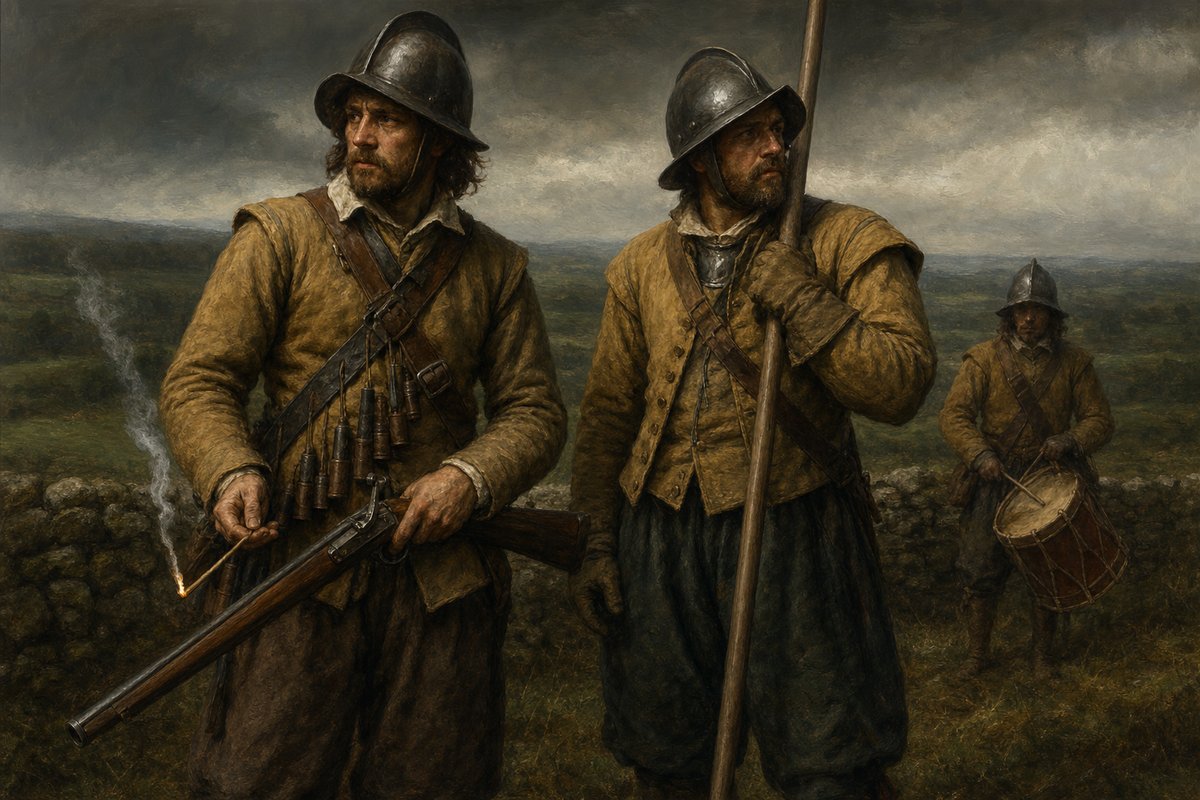
Protective equipment varied widely by rank and regiment. Infantry pikemen often wore a breastplate, backplate, and helmet. Cavalry troopers in Parliament's New Model Army standardised on the distinctive three-barred lobster-pot helmet and a thick buff leather coat that could turn a sword stroke. By the time of Torrington, the full armour of the early war years was already being abandoned as too heavy and impractical.
Social Conditions in the 1640s
England in the 1640s was a society in which perhaps three quarters of the population lived in rural areas and depended on agriculture. The gentry class — landowners below the level of the aristocracy — dominated local government and provided the officers of both armies. Below them, yeomen farmers, craftsmen, and agricultural labourers made up the bulk of the population.
"The country people are put to great hardship — soldiers quartered upon them take what they list, paying nothing, leaving families without so much as bread for their children."
The war imposed enormous burdens on civilian populations. Soldiers were billeted on households that were expected to feed and lodge them. Armies required vast quantities of food, fodder, and supplies, which were frequently requisitioned from local communities. Towns that found themselves in disputed territory might be forced to provision both sides at different times. Areas that witnessed fighting — like Great Torrington — suffered direct physical damage and civilian casualties.
The Living-History Tradition
Interest in the English Civil War has generated one of the world's most active living-history communities. The Sealed Knot, founded in 1968, organises reenactment events at Civil War sites across England, recreating the battles and camp life of the 1640s with period-accurate equipment and clothing. Its membership numbers in the thousands, divided between Royalist and Parliamentarian regiments.
Living-history reenactment serves both as entertainment and as a form of public history. By recreating the equipment, drill, and daily routines of 17th-century soldiers, reenactors help audiences understand the physical realities of the period in ways that books and museums alone cannot convey. The sounds of pike drill, the smell of black powder, and the sight of a cavalry charge provide visceral connections to a past that might otherwise remain abstract.
The battle of Torrington in 1646 has been commemorated through reenactment events over the years, bringing the history of the Civil War in Devon to new audiences and maintaining the memory of the men who fought and died in the streets of the town on that February night.
Frequently Asked Questions
What weapons were used in the English Civil War?
Civil War armies used a mix of firearms and edged weapons. Infantry carried matchlock muskets — slow to load and unreliable in wet weather — alongside pikes up to 18 feet long. Cavalry used pistols, carbines, and swords. Artillery ranged from small field guns to larger siege pieces. The introduction of the flintlock musket during the war period gradually improved infantry firepower.
↑ Read more: Weapons and Equipment
What were Civil War soldiers called?
The two main factions were known as Royalists (also called Cavaliers) and Parliamentarians (also called Roundheads, though this term was originally derogatory). Infantry were divided into musketeers and pikemen. Cavalry troopers were organised into regiments of horse. Dragoons were mounted infantry who rode to battle but typically fought on foot.
↑ Read more: The Armies of the Civil War
How were Civil War armies organised?
Both sides organised their armies into regiments, each nominally commanded by a colonel. Infantry regiments contained companies of musketeers and pikemen. Cavalry regiments were organised into troops. The New Model Army, created by Parliament in 1645, introduced greater standardisation — all cavalry wore lobster-pot helmets and buff coats, and infantry wore red coats, establishing a tradition that persisted into the 18th century. See also the key commanders who shaped that army.
↑ Read more: The Armies of the Civil War
What was everyday life like for a Civil War soldier?
Life for an ordinary soldier was harsh. Pay was irregular, food supplies uncertain, and disease killed more men than combat. Soldiers were billeted on local civilians, who were expected to provide food and lodging — a significant burden. Sieges, which made up much of Civil War fighting, involved long periods of boredom punctuated by dangerous assaults. The Battle of Torrington was one such violent culmination after months of siege and manoeuvre.
↑ Read more: Social Conditions in the 1640s
What was 17th-century England like socially?
English society in the 1640s was rigidly hierarchical, with aristocracy and gentry at the top, followed by yeomen farmers, craftsmen, and labourers. Most people lived in rural areas and worked in agriculture. The Civil War disrupted these hierarchies — the New Model Army promoted men on merit, and the resulting political upheaval (including the execution of Charles I in 1649) was genuinely revolutionary for the age. For how this played out in the South West, see The English Civil War in Devon.
↑ Read more: Social Conditions in the 1640s
What is Civil War reenactment?
Civil War reenactment is a living-history tradition in which enthusiasts recreate the battles, equipment, and daily life of the 1640s. The Sealed Knot, founded in 1968, is one of the oldest and largest reenactment societies in the world, with thousands of members recreating both Royalist and Parliamentarian units. Events take place at historic sites across England throughout the year, including at Great Torrington.
↑ Read more: The Living-History Tradition
Were there women involved in the English Civil War?
Women played significant roles, though they did not typically serve as soldiers. Many women defended besieged houses and castles — Basing House and Lathom House are notable examples. Women also served as nurses, sutlers (camp traders), and intelligence agents. The siege conditions at Plymouth involved the entire civilian population, including women and children, in the town's survival. The full story of that siege is told in The English Civil War in Devon.
↑ Read more: Social Conditions in the 1640s
How accurate are Civil War reenactments?
Modern reenactment groups invest considerable effort in historical accuracy, using period-appropriate clothing, armour, and weapons (modified for safety). Organisations such as the Sealed Knot work with historians and museums to ensure their presentations reflect what is known about 17th-century military practice. No reenactment can perfectly replicate the experience of actual combat, but the best events provide a vivid impression of the period.
↑ Read more: The Living-History Tradition